---
title: "Clarity in Packaging: PET vs PP Is No Longer a Trade-Off"
description: Consumers buy with their eyes. See how clarified polypropylene closes the PET vs PP optical gap, and what it means for your packaging decisions.
image: https://blog.icpg.co/hubfs/pet-vs-pe.jpg
---
[](https://icpg.co/)
- [Markets](https://icpg.co/markets/)
- [Apple Sauce](https://icpg.co/markets/apple-sauce/)
- [Baby Food](https://icpg.co/markets/baby-food/)
- [Beverages](https://icpg.co/markets/beverages/)
- [Yogurt and Dairy](https://icpg.co/markets/yogurt-and-dairy/)
- [Coffee And Tea](https://icpg.co/markets/coffee-and-tea/)
- [Condiments and Dip](https://icpg.co/markets/condiments-and-dipping-sauces/)
- [Food Service](https://icpg.co/markets/food-service/)
- [Marijuana and CBD](https://icpg.co/markets/marijuana-and-cbd/)
- [On-the-go](https://icpg.co/markets/on-the-go/)
- [Pet Food](https://icpg.co/markets/pet-food/)
- [Snack Packs](https://icpg.co/markets/snack-packs/)
- Materials +
Applications
- Materials
- [XPP Solutions](https://icpg.co/materials-and-applications/xpp/)
- [Polypropylene (PP)](https://icpg.co/materials-and-applications/polypropylene-pp/)
- [Polystyrene (PS)](https://icpg.co/materials-and-applications/polystyrene-ps/)
- [High Density Polyethylene (HDPE)](https://icpg.co/materials-and-applications/high-density-polyethylene-hdpe/)
- [PET](https://icpg.co/materials-and-applications/polyethylene-terephthalate/)
- Applications
- [Thermoform Containers](https://icpg.co/materials-and-applications/thermoform-containers/)
- [Form Fill Seal](https://icpg.co/materials-and-applications/form-fill-seal/)
- [Aseptic](https://icpg.co/materials-and-applications/aseptic/)
- [Hot Fill](https://icpg.co/materials-and-applications/hot-fill/)
- [Retort](https://icpg.co/materials-and-applications/retort/)
- [Modified Atmosphere Packaging (MAP)](https://icpg.co/materials-and-applications/modified-atmosphere-packaging-map/)
- [High Pressure Processing (HPP)](https://icpg.co/materials-and-applications/high-pressure-processing-hpp/)
- [Deposit-Fill-Seal](https://icpg.co/materials-and-applications/deposit-fill-seal/)
- Capabilities
- [Performance Additives](https://icpg.co/capabilities/specialty-additives/)
- [Thermoforming](https://icpg.co/capabilities/thermoforming/)
- [Custom Development](https://icpg.co/custom-development/)
- [Extrusion Capabilities](https://icpg.co/capabilities/extrusion-capabilities/)
- [visionX System](https://icpg.co/capabilities/visionx-system/)
- [About Us](https://icpg.co/about-us/)
- [Quality Control](https://icpg.co/about-us/quality-control/)
- [Sustainability](https://icpg.co/about-us/sustainability/)
- [Careers](https://icpg.co/about-us/careers/)
- [Resources](https://icpg.co/resources/)
- [Industry Insights](https://blog.icpg.co)
- [Contact Us](https://icpg.co/about-us/contact-us/)
- [The C.A.P. Pack Podcast](https://icpg.co/podcast/)
[Start Your Project](https://icpg.co/about-us/contact-us/)
- [Markets](https://icpg.co/markets/)
- [Apple Sauce](https://icpg.co/markets/apple-sauce/)
- [Baby Food](https://icpg.co/markets/baby-food/)
- [Beverages](https://icpg.co/markets/beverages/)
- [Yogurt and Dairy](https://icpg.co/markets/yogurt-and-dairy/)
- [Coffee And Tea](https://icpg.co/markets/coffee-and-tea/)
- [Condiments and Dip](https://icpg.co/markets/condiments-and-dipping-sauces/)
- [Food Service](https://icpg.co/markets/food-service/)
- [Marijuana and CBD](https://icpg.co/markets/marijuana-and-cbd/)
- [On-the-go](https://icpg.co/markets/on-the-go/)
- [Pet Food](https://icpg.co/markets/pet-food/)
- [Snack Packs](https://icpg.co/markets/snack-packs/)
- Materials +
Applications
- Materials
- [XPP Solutions](https://icpg.co/materials-and-applications/xpp/)
- [Polypropylene (PP)](https://icpg.co/materials-and-applications/polypropylene-pp/)
- [Polystyrene (PS)](https://icpg.co/materials-and-applications/polystyrene-ps/)
- [High Density Polyethylene (HDPE)](https://icpg.co/materials-and-applications/high-density-polyethylene-hdpe/)
- [PET](https://icpg.co/materials-and-applications/polyethylene-terephthalate/)
- Applications
- [Thermoform Containers](https://icpg.co/materials-and-applications/thermoform-containers/)
- [Form Fill Seal](https://icpg.co/materials-and-applications/form-fill-seal/)
- [Aseptic](https://icpg.co/materials-and-applications/aseptic/)
- [Hot Fill](https://icpg.co/materials-and-applications/hot-fill/)
- [Retort](https://icpg.co/materials-and-applications/retort/)
- [Modified Atmosphere Packaging (MAP)](https://icpg.co/materials-and-applications/modified-atmosphere-packaging-map/)
- [High Pressure Processing (HPP)](https://icpg.co/materials-and-applications/high-pressure-processing-hpp/)
- [Deposit-Fill-Seal](https://icpg.co/materials-and-applications/deposit-fill-seal/)
- Capabilities
- [Performance Additives](https://icpg.co/capabilities/specialty-additives/)
- [Thermoforming](https://icpg.co/capabilities/thermoforming/)
- [Custom Development](https://icpg.co/custom-development/)
- [Extrusion Capabilities](https://icpg.co/capabilities/extrusion-capabilities/)
- [visionX System](https://icpg.co/capabilities/visionx-system/)
- [About Us](https://icpg.co/about-us/)
- [Quality Control](https://icpg.co/about-us/quality-control/)
- [Sustainability](https://icpg.co/about-us/sustainability/)
- [Careers](https://icpg.co/about-us/careers/)
- [Resources](https://icpg.co/resources/)
- [Industry Insights](https://blog.icpg.co)
- [Contact Us](https://icpg.co/about-us/contact-us/)
- [The C.A.P. Pack Podcast](https://icpg.co/podcast/)
[Start Your Project](https://icpg.co/about-us/contact-us/)
[](https://icpg.co/)
-
[](https://icpg.co) 
### August 5th, 2026
# The Science of Clarity in Packaging: Why PET vs PP Is No Longer a Trade-Off
-
-
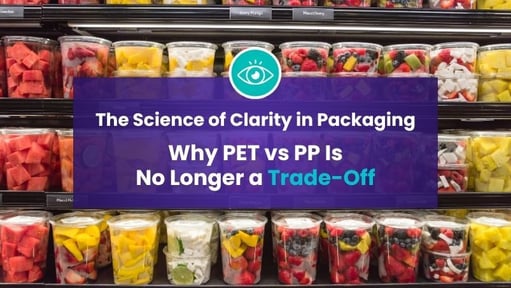Walk down any refrigerated aisle and one thing stays consistent. Shoppers want to see what they are buying.
That is more than a design preference. It is backed by consumer research. Studies have consistently shown that transparent packaging increases perceived freshness, product quality, attractiveness and purchase intention, particularly in fresh food categories where shoppers rely on visual inspection before they commit.
That single preference is what turns PET vs PP into more than a materials spec decision.
For packaging teams, that finding creates a specific bind. The technical case for moving from [PET to polypropylene](https://blog.icpg.co/exploring-pet-packaging-material-icpg) is strong: lower density, a better fit with mono-material recycling and a process window suited to form-fill-seal. But PET has long owned clarity, and clarity is the one attribute your marketing and category teams will refuse to trade away.
That trade-off is what has changed.
## Why Does Clarity Matter in Food Packaging?
Shoppers make purchasing decisions in seconds, relying heavily on visual cues. In food categories especially, being able to see the product lets a shopper evaluate color, texture and freshness, the attributes most closely associated with quality.
- Research has consistently associated transparent packaging with:
- Increased perceptions of freshness
- Higher perceived product quality
- Greater transparency and trust
- Enhanced product attractiveness
- Stronger purchase intention
These effects are most pronounced in fresh food categories, where shoppers want reassurance that a product meets expectation before it goes in the cart. Letting the product show can carry as much weight as the graphics printed on the package, which is often what decides whether a product holds its own on a crowded shelf.
For a packaging engineer, the practical consequence is this. Treat clarity as a functional specification in the material brief, not a preference to be negotiated later. If it is not written down at the start, it resurfaces as a late-stage objection after months of qualification work.
## The Packaging Challenge
For years, brand owners have had to balance optical performance against everything else on the requirements list.
[PET](https://icpg.co/materials-and-applications/polyethylene-terephthalate/) became the default for applications demanding clarity and gloss, and for good reason. It is optically excellent as supplied, with high light transmission, low haze and strong surface gloss.
[Polypropylene](https://blog.icpg.co/polypropylene-the-ideal-material-for-rigid-food-packaging) came to the same conversation carrying a handicap. PP offers real advantages in recyclability, weight reduction and processing efficiency, but it has historically been seen as the weaker performer on optics. There is a physical reason for that reputation. PP is semi-crystalline, and in its natural state those crystal structures scatter light, which is what makes unmodified PP look hazy.
So teams learned to treat the decision as a trade. PET for the look. PP for the weight, the recycling stream and the line performance.
As more brands commit to recyclable mono-material packaging, that trade has become harder to accept.
## How Has Polypropylene Technology Solved the Clarity Problem?
The haze in polypropylene turned out to be a crystallization problem. Crystallization is something you can control.
Clarifying agents work by raising the rate of nucleation. More crystals form within the same volume, which means each individual crystal grows smaller than it otherwise would. Once those crystals are small relative to the wavelength of visible light, they scatter far less of it. The material transmits light rather than diffusing it, and haze falls sharply.
The result is polypropylene engineered to deliver optical properties that closely resemble PET while keeping the performance advantages that made PP attractive in the first place. Brand owners no longer have to choose between a recyclable packaging strategy and the shelf appeal that drives purchase.
This is the same engineering behind what the industry calls clear polypropylene: a material that looks like PET on the shelf and processes like PP on the line.
This changes how a material comparison should be run. Most PET vs PP evaluations still benchmark against unmodified PP, a material nobody would specify for a clarity-critical application anyway. Benchmark against a clarified grade instead, or the comparison answers a question you were never asking.
## Clarity Without Compromise
ICPG's [XPP® Polypropylene Solutions](https://icpg.co/materials-and-applications/xpp/) were developed as a recyclable alternative to polystyrene and to many PET packaging applications, while delivering the optical performance brands expect.
Designed for rigid [thermoformed](https://icpg.co/materials-and-applications/thermoform-containers/)and form-fill-seal food packaging, XPP offers clarity and gloss alongside the stiffness, processability and performance that demanding applications require, including the snap that multi-pack formats depend on.
Beyond optics, XPP offers:
- Clarity and gloss suited to premium shelf appeal
- Compatibility with existing thermoforming and form-fill-seal equipment
- Potential material yield improvements compared to PET, depending on package design and application
- Recyclable [mono-material polypropylene structures](https://blog.icpg.co/is-pet-recyclable-icpg) that support circular packaging goals
The result is a material that lets brands keep product visibility and consumer appeal while advancing packaging performance and sustainability targets.
If you are working through the specifics, our [guide to evaluating XPP for PS and PET replacement in FFS](https://info.icpg.co/guide-to-evaluating-xpp-for-ps-and-pet-replacement-in-ffs) covers the comparison in more depth.
## Qualification Is the Real Timeline
One thing we will not oversimplify. Changing a material in food packaging is not a purchase decision. It is a qualification program.
Depending on the [application](https://icpg.co/materials-and-applications/), that can involve formulation trials, thermoforming or FFS line trials, seal integrity and drop testing, shelf-life validation, tooling assessment and internal sign-off across quality, operations and marketing. For a large brand owner, months is normal. Longer is not unusual.
We raise it early on purpose. The teams that succeed at material transitions are the ones that started the conversation before a deadline forced it. The ones that struggle are the ones that treated a [material change](https://blog.icpg.co/3-factors-that-influence-the-true-cost-of-material-replacement) as a procurement line item.
Clarity is what your shopper notices first. Qualification is what determines whether the package ever reaches the shelf.
## PET vs PP: Frequently Asked Questions
### Is Polypropylene Clear?
Unmodified polypropylene is translucent and hazy, because its crystal structures scatter light. Clarified polypropylene grades, produced using clarifying additives, are substantially clearer and are used in applications where product visibility drives purchase.
### Can Polypropylene Be Made as Clear as PET?
Clarified PP grades deliver optical properties that closely resemble PET. Whether a specific grade meets a specific application's clarity requirement depends on gauge, part geometry and formulation, and is confirmed through material trials.
### What Is the Difference Between PET and PP in Food Packaging?
PET offers excellent as-supplied optical clarity. PP is lower in density, performs differently under heat and recycles as a mono-material. Clarified PP grades have closed the historical optical gap, which makes the comparison more application-dependent than it used to be.
### Is Clarified Polypropylene Recyclable?
Yes. Clarifying additives do not remove polypropylene from the PP recycling stream. Mono-material PP structures are recyclable through existing PP collection and reprocessing.
### How Long Does It Take to Qualify a New Packaging Material?
For a large brand owner, months is typical and longer is common. Qualification generally includes formulation trials, line trials, seal and drop testing, shelf-life validation and internal sign-off across quality, operations and marketing.
## Looking Ahead
Packaging shapes purchasing decisions long before a consumer experiences the product itself. Clarity is among the first cues a shopper uses to judge freshness, quality and value.
As brands keep balancing consumer expectations against sustainability commitments, materials that hold premium shelf appeal while supporting recyclable structures will matter more, not less. XPP® Polypropylene Solutions show that optical performance and sustainability are no longer competing choices.
If your team is weighing PET vs PP for a clarity-critical application, the useful next step is not another spec sheet comparison. It is a conversation about your application, your line and your timeline. [Start the conversation](https://icpg.co/about-us/contact-us/) with ICPG's packaging team, and get a straight answer on what a transition would actually look like for your line.
### [Unlocking Freshness and Safety: Use of ... In the ever-evolving world of food packaging, few innovations have been as impactful - or as promising - as High Pressure Processing (HPP). ...](https://blog.icpg.co/hpp-in-food-packaging-extending-freshness-safety)
### [Podcast S2 E11: Debunking 10 Common ... Welcome back to the Crazy About Packaging podcast! In Episode 11, the Cap Pack — Natalie, Mike, and Jonathan — are ready to start calling ...](https://blog.icpg.co/crazy-about-packaging-season-2-episode-11-debunking-packaging-myths)
## Interested in reading more?
[Back to Blog](https://blog.icpg.co)
[](https://icpg.co)
[](https://www.impactplastics.co)
© Impact Consumer Products Group – All Rights Reserved 2020
- [Privacy Policy](https://icpg.co/privacy-policy/)
5 Highland Drive
Putnam, CT 06260
Phone: 860-963-1976
General Fax: 860-963-1998
- Stay Connected
- [Twitter](https://twitter.com/icpgco)
- [LinkedIn](https://www.linkedin.com/company/icpgco)
- [Instagram](https://www.instagram.com/icpgco/)
- [Facebook](https://www.facebook.com/ICPG-Food-Packaging-101654432099724)
```json
{
"@context" : "https://schema.org",
"@type" : "BlogPosting",
"author" : {
"@type" : "Person",
"name" : "Natalie MacVarish",
"url" : "https://blog.icpg.co/author/natalie-macvarish"
},
"dateModified" : "2026-08-31T17:05:51.243Z",
"datePublished" : "2026-08-05T15:27:44.000Z",
"headline" : "Clarity in Packaging: PET vs PP Is No Longer a Trade-Off",
"image" : [ "https://blog.icpg.co/hubfs/pet-vs-pe.jpg" ],
"mainEntityOfPage" : {
"@id" : "https://blog.icpg.co/clarity-in-packaging-pet-vs-pp-is-no-longer-a-trade-off",
"@type" : "WebPage"
},
"publisher" : {
"@type" : "Organization",
"logo" : {
"@type" : "ImageObject",
"url" : "https://blog.icpg.co/hubfs/ICPG_logo_RGB-1.png"
},
"name" : "ICPG"
}
}
```
```json
{
"@context" : "https://schema.org",
"@type" : "FAQPage",
"mainEntity" : [ {
"@type" : "Question",
"acceptedAnswer" : {
"@type" : "Answer",
"text" : "Unmodified polypropylene is translucent and hazy because its crystal structures scatter light. Clarified polypropylene grades, produced using clarifying additives, are substantially clearer and are used in applications where product visibility drives purchase."
},
"name" : "Is Polypropylene Clear?"
}, {
"@type" : "Question",
"acceptedAnswer" : {
"@type" : "Answer",
"text" : "Clarified PP grades deliver optical properties that closely resemble PET. Whether a specific grade meets a specific application's clarity requirement depends on gauge, part geometry and formulation, and is confirmed through material trials."
},
"name" : "Can Polypropylene Be Made as Clear as PET?"
}, {
"@type" : "Question",
"acceptedAnswer" : {
"@type" : "Answer",
"text" : "PET offers excellent as-supplied optical clarity. PP is lower in density, performs differently under heat and recycles as a mono-material. Clarified PP grades have closed the historical optical gap, which makes the comparison more application-dependent than it used to be."
},
"name" : "What Is the Difference Between PET and PP in Food Packaging?"
}, {
"@type" : "Question",
"acceptedAnswer" : {
"@type" : "Answer",
"text" : "Yes. Clarifying additives do not remove polypropylene from the PP recycling stream. Mono-material PP structures are recyclable through existing PP collection and reprocessing."
},
"name" : "Is Clarified Polypropylene Recyclable?"
}, {
"@type" : "Question",
"acceptedAnswer" : {
"@type" : "Answer",
"text" : "For a large brand owner, months is typical and longer is common. Qualification generally includes formulation trials, line trials, seal and drop testing, shelf-life validation and internal sign-off across quality, operations and marketing."
},
"name" : "How Long Does It Take to Qualify a New Packaging Material?"
} ]
}
```