


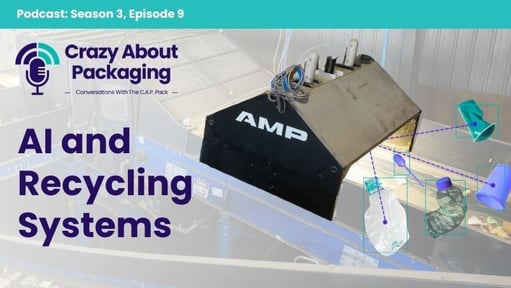
 Welcome back to Crazy About Packaging. In this episode, the C.A.P. Pack sat down with Joe Castagneri, Director of Software at AMP, to talk about AI-powered sortation, recycling recovery, and what it looks like when software, robotics, and waste systems all meet on the same conveyor belt.
AI is everywhere right now, and it can be difficult to wrap your head around the massive variety of tools and applications. Joe helped us zoom in on the AI and recycling conversation: we got into what AI sortation actually is, what it can do inside a recycling facility, and how it could help recover more material from systems that already exist today.
Sneak Peek for Episode 9
Watch the full episode above or listen now on Spotify, Apple Podcasts, or our website. Want a sneak peek? Here’s a look at a few of the biggest points from the conversation.
Meet Our Guest Host: Joe Castagneri
Joe is Director of Software at AMP, an AI-powered sortation company focused on improving recycling and waste recovery systems. He joined the company early, back when AMP was still small and trying to prove that AI, robotics, and recycling could work together in a real facility, not just on paper.
He has spent the last decade working across machine learning, computer vision, robotics, and facility software. That gave him a wide view of the whole system, from how the model sees material on the belt to how the robot responds to it to how facilities track what is actually being recovered.
That range came through in this episode. Joe could explain the technical side without making it sound dense, and he could also bring it back to the business side of recycling, where speed, cost, labor, and end markets all shape what is actually possible.
Yes, Recycling Is Real (But It’s Also a Business)
We’ve talked about consumers’ lack of faith in the recycling system a lot (and yes, we do mean a lot — check out S3E5, S1E9, S2E12, S2E3, S2E11, and S2E9 for a taste!). We keep coming back to the same point over and again: many consumers simply don’t believe that recycling actually happens.
Joe’s trying to put this rumor to bed. “Recycling’s real!”
He also put his finger on why so many people still feel frustrated by it. For recycling to work, there has to be enough material, enough sorting capacity, and an end market ready to buy what comes out the other side.
And that’s where the business side comes in. Joe said it plainly: “It has to meet the market where it is as well.” Recycling runs inside a narrow-margin industry. If a material cannot be sorted profitably, sold profitably, or moved in enough volume to justify the effort, it is much less likely to get recycled, no matter how badly people want it to.
This is a big part of why better recovery systems matter. These systems don’t just recover more material, they reduce sortation costs, improve bale quality, and make more materials economically viable.
Trash Robots, Computer Vision, and Fast Decisions
At the center of AMP’s system is a pretty simple idea: use AI to identify materials on the line, then use robotics or air sortation to pull the right items out of the stream.
That sounds simple enough on paper. In practice, it means teaching a system to recognize specific materials as they move across a conveyor belt, make a decision almost instantly, and sort those items with speed and consistency inside a real recycling facility.
AMP’s systems use computer vision models trained on images. From there, cameras within sorting facilities look at the material on the belt, the model identifies what is there and where it is, then the system tells a robot or air sortation unit what to grab and when to do it.
Joe also broke down how this differs from the kind of AI most people are familiar with right now. Large language models (LLMs) work with text, while AMP’s models work with images. While the general concept is similar, the AI sortation model has a very different job to do — and it has to be done fast.
As Joe explained, the belt is moving quickly, so the system only has “a couple hundred milliseconds” to see the object, classify it, and act. That speed is part of the reason AMP works with smaller computer vision models instead of the giant models people usually associate with AI.
The Identification Game: Where AI and Recycling Get Powerful
AMP’s models aren’t just looking for “plastic.” They can sort by form, resin family, color, and other traits all at once. A bottle isn’t the same as a tub and a tub isn’t the same as a lid. That level of detail gives facilities a much better shot at pulling the right material into the right stream.
Joe had a pretty great way of showing where the system stops, too. It’s trained on repeated exposure to specific items it needs to know, but it doesn’t know anything beyond that. “If I crawl under the camera, it’s gonna label me as ‘miscellaneous.’ It doesn’t know. It’s not aware of the world beyond [what it’s trained to recognize].”
That’s part of what makes the whole thing work. The system knows what it’s been trained to know. And if a facility wants it to start spotting something new, that can be added to the dataset and trained in for future use. This is a massive advantage which allows facilities to change what they are targeting at different points in the line without rebuilding the whole system. “We can actually just click a button and sort something different there,” he said.
That could mean sorting aluminum at one point today and targeting plastic bottles there later if the material mix or the business case changes.
Bale Quality Is Not a Guessing Game
For recovery systems, quality is a must: a bale of recovered PET is supposed to be made up of PET. But in practice, quality can vary a lot, and checking that quality is not simple.
So what are your options? With legacy systems, it comes down to two choices:
-
Run the material and see what kind of output you get
-
Break open a bale and sort through hundreds of pounds of material by hand
But with AI, this process can be simplified. AMP uses the same kind of camera system to monitor what ends up in the bale. Joe described it as a “live report card” for commodity purity. That kind of visibility could go a long way for anyone trying to improve consistency in recycled feedstock.
AI and Recycling Beyond the Bin
Too often, material recovery relies on end users putting their materials into the right streams — but what happens when they don’t? Materials that could be recaptured instead wind up in landfills.
AMP is working to change this. In Virginia, their technology is helping to process municipal solid waste and pull recyclables out before that material reaches the landfill. Joe framed it around three problems showing up at once:
-
Landfills filling up too fast
-
Methane coming off buried waste
-
Only about a third of recyclables make it into the recycling bin
In the Virginia region, this approach has already raised the recycling rate from 8% to 20%.
As Natalie put it, there’s only so much you can ask people to do. Most people are not going to learn every resin type, every local rule, and every exception. Recovering more material without asking more from the consumer changes the equation, and can be the key to helping the plastics industry reach its goals faster.
Keep Getting Crazy About Packaging
Thanks for tuning in to the latest episode of Crazy About Packaging. We had a great time talking with Joe Castagneri, and this one gave us a lot to think about, from how AI sortation works on the line to what it could mean for recovery, recyclability, and the future of waste systems.
Be sure to listen to the full episode on Spotify, Apple Podcasts, or our website. And if you want to keep up with future episodes, subscribe and follow along. We’ve got plenty more packaging conversations coming your way.
Got a question you’d like us to cover in a future episode? Send it our way. You can also follow ICPG on social media to keep the conversation going and stay up to date on new podcast episodes, blog posts, and packaging insights from the C.A.P. Pack.