


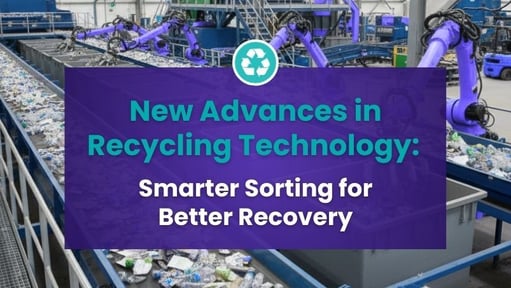
 For years, conversations about recycling have focused on collection rates, consumer behavior, and end markets. But inside material recovery facilities (MRFs) and plastics recycling operations, there’s a growing consensus around a different reality: recycling outcomes are determined by how well materials are identified and separated, not just by whether they’re technically recyclable.
Today’s packaging is more complex than ever. Between multilayer films, dark plastics, and food-contact coatings, traditional sortation systems aren’t equipped to keep up. Fortunately, new advances in recycling technology are closing the gap between recyclability and recovery, making it easier for companies to align packaging performance with real-world sorting.
Below, we explore three of the most important innovations reshaping recycling sortation today, and what they mean for the future of material recovery.
Why Sortation Is the Real Bottleneck
Mechanical recycling is only as effective as the purity of its inputs. Even highly recyclable materials like polypropylene (PP) and polyethylene terephthalate (PET) lose value when streams are contaminated, mixed across grades, or improperly routed. In practice, poor identification is one of the biggest reasons recyclable materials fail to be recovered.
Modern MRFs rely heavily on near-infrared (NIR) optical sorting, which has dramatically improved recovery rates for major polymer families like PET, PP, and PE. But NIR systems are fundamentally designed to answer a limited question: What type of polymer is this?
That approach struggles when materials:
- Are black or very dark
- Contain fillers, additives, or coatings
- Appear similar at the polymer level but differ by application (e.g., food vs non-food)
- Require separation by grade, not just resin family
The result is often good recovery but inconsistent purity. And, unfortunately, purity is what determines value. This is where many new advances in recycling technology are now focused: improving identification accuracy upstream to protect downstream value.
Innovation #1: AI + Hyperspectral Imaging
Hyperspectral imaging is the next evolution in optical sorting. Instead of capturing a small number of spectral bands like traditional NIR systems, hyperspectral cameras collect hundreds of data points for each item moving down the belt.
When paired with machine-learning models, this technology can detect subtle differences in material composition that were previously invisible. These systems improve over time as datasets expand and models are refined.
What’s new:
- Processing speeds now support high-throughput industrial lines
- AI models improve over time with better training data
- Detection performance has improved for carbon-black plastics, mineral-filled resins, and coated materials
Why it matters:
- Enables higher-purity output streams critical for closed-loop recycling
- Improves food-grade PCR recovery
- Reduces false positives and cross-contamination
Challenges:
- Higher capital investment than standard NIR
- Requires quality datasets and ongoing calibration
- Still challenged by highly complex multilayer structures
Hyperspectral systems don’t solve every problem, but they significantly narrow the gap between what’s on the belt and what the sorter can actually recognize. As one of the most impactful new advances in recycling technology, they are redefining what automated sortation can achieve.
Innovation #2: Digital Watermarks
Digital watermarking takes a different approach to sortation. Instead of relying on material properties alone, this technology embeds an imperceptible code directly into packaging artwork. High-speed cameras and software detect the watermark on the sorting line and use it to route the item appropriately.
Recent industrial trials have demonstrated that digital watermarks can be detected at scale, across millions of packages and thousands of SKUs, with detection rates frequently exceeding 90% under controlled conditions.
What’s new:
- Trials have achieved >90% detection rates at industrial scale
- Technology is being standardized across packaging formats
- Supported by industry groups like the HolyGrail 2.0 initiative
Why it matters:
- Moves sortation from material-based to attribute-based
- Enables sorting by:
- Food vs non-food use
- Packaging format
- Program or brand participation
- Reduces dependence on consumers sorting “correctly”
Challenges:
- Requires broad adoption by brands and converters
- Needs standardization and governance around how data is defined and managed
- Requires upgrades to sorting infrastructure
Digital watermarks don’t fix recycling on their own, but they fundamentally change how precisely materials can be identified. They represent one of the most promising new advances in recycling technology for packaging differentiation.
Innovation #3: Tracer-Based Sorting
Tracer-based sorting embeds fluorescent markers into plastic at the resin or compounding stage. These tracers are invisible during use but can be detected by UV or laser-based sensors during sorting.
Because the identifier is part of the material itself, tracer-based systems can enable highly precise separation even for black plastics or visually identical parts.
What’s new:
- Improved tracer materials now withstand processing and use
- Sensor technologies are becoming more sensitive and scalable
- Standards are emerging for use in food-contact and PCR applications
Why it matters:
- Enables grade-level separation, not just polymer family
- Works on black and dark plastics
- Can distinguish virgin vs PCR or food-contact vs non-food materials
- Works best in closed-loop or controlled supply chains or high-value applications where purity justifies this level of coordination
Challenges:
- Requires upstream resin adoption
- Food-contact compliance and regulatory approval are still evolving
- Industry standards are still evolving
Tracer-based sorting is powerful, but it works best where supply chains are aligned and participation is intentional.
The Bigger Shift: Identification as Recycling Infrastructure
These technologies are often framed as competing solutions. In reality, they are complementary.
The future of recycling isn’t one breakthrough machine. Instead, it’s a layered identification and separation stack, where each technology addresses a different limitation:
AI + hyperspectral imaging improves whole-object recognition
- Digital watermarks enable attribute-level routing
- Tracer-based sorting enables grade-level precision
- Mechanical separation refines material post-grind
Together, they’re helping us make a change and allowing us to move from asking consumers to do more to building systems that can finally recognize what’s already there. This approach defines the next wave of new advances in recycling technology.
What This Means for You
For MRFs and recyclers: Better identification leads directly to better economics: higher-value outputs, fewer rejects, and less reliance on manual intervention.
For brand owners: Design-for-recycling increasingly means design-for-detectability. Material choice alone is no longer enough without considering how packaging will be identified at scale.
For materials and packaging companies: Innovation must align with the realities of sortation. Compatibility with emerging identification systems is becoming a competitive advantage rather than a nice-to-have.
New Advances in Recycling Technology FAQ
Q: What is the biggest challenge in modern recycling?
The main barrier is accurate identification and separation. Even recyclable materials are lost when sortation systems can’t recognize or properly route them.
Q: How are new advances in recycling technology changing packaging?
They’re pushing brands to design packaging for detectability, ensuring materials can be accurately identified and sorted during the recycling process.
Q: How does hyperspectral imaging improve recycling?
It captures hundreds of data points per item. Paired with AI, it can identify subtle differences in composition that traditional NIR systems often miss.
Q: What are digital watermarks in recycling?
These are imperceptible codes embedded into the packaging artwork. Detection systems read them during sortation to route items based on attributes like food contact or packaging format.
Q: Who benefits from tracer-based sorting?
Applications that demand high purity, such as closed-loop systems or food-grade PCR streams, see the greatest value. Tracers allow precise sorting by grade, origin, or usage.
Ready to Talk Materials That Work for Your Recovery Goals?
Recycling doesn’t fail because materials can’t be recycled. It fails when we can’t reliably identify and separate them at scale. New advances in recycling technology are changing that reality, but material choices still matter.
If you're reevaluating your packaging materials in light of evolving recycling technology, ICPG can help you align material performance with real-world recovery systems. We work directly with manufacturers and brand owners to ensure packaging not only performs on the shelf, but has a better chance of actually being recovered and recycled.
Let’s talk about how your material choices can support recovery, meet safety regulations, and align with future-facing sortation systems. Reach out to our team to start your material review process today.