


Welcome back to Crazy About Packaging! We're kicking off Season 4 with a question that's getting harder to answer every year: is the packaging you're designing today still going to make sense in five or ten years?
For a long time, material decisions came down to performance, availability and cost. Those factors still matter, but they're no longer the only things on the list. Between regulations like PPWR and California's SB 54, shifting recycling infrastructure, and real changes in production capacity, the material selection decision casts a much longer shadow than it used to.
Last season we looked at what actually drives packaging cost beyond price per pound. This time we're looking further out: what goes into a packaging material strategy, what's driving the shift toward long-term material planning, and which signals packaging teams should be paying attention to right now.
Sneak Peek for Season 4, Episode 1
You can watch the full episode above or listen on Spotify, Apple Podcasts, or on our website.
Here's a preview of a few moments from the conversation.
Plan or Panic? A Lightning Round to Open the Season
We started with a game: "Plan on Panic?" Natalie read out a series of packaging industry scenarios, and the rest of us had to call each one: is this news you plan for, or news you panic about?
Here's what was on the table:
- A hurricane temporarily shuts down Gulf Coast resin production
- PPWR is finalized in Europe
- Resin prices increase by 15%
- A major polystyrene plant permanently closes
The answers varied quite a bit, because these scenarios fell on a wide range — some, like PPWR, have been talking points for years, so our hosts believed most industry professionals should already be planning for them. Others, like a hurricane or major plant shortage, are more likely to send people into a temporary panic while they implement short-term solutions to keep their product moving.
Where do you fall on these items? Are they indicators that you should start planning, or that it's time to panic? Watch the episode to hear what our hosts thought about these scenarios.
Material Planning is Increasing in Complexity
Twenty or thirty years ago, packaging decisions were mostly business and application decisions that came down to performance, availability, cost. Compared to what a company weighs today, it was relatively simple.
"It always used to be called Procurement. Now it's called Supply Chain," Jonathan explained, pointing out that job titles have shifted as the task of material selection and acquisition has gotten more complicated. "There's a reason why it's called supply chain, because there are so many factors that can impact that which you have to be aware of."
That widening scope is why packaging material strategy can't be developed in a vacuum anymore. Sustainability has a stake. So does engineering, operations and supply chain. Everyone has to weigh in, because the material has to work for all of it at once. And nobody wants to spend the time and money qualifying a new material only to find out in a few years that it wasn't the right long-term fit.
The Risk of Painting Yourself Into a Corner
Too often, companies find themselves with only one path: Their product is being packaged with a particular material, run on their particular lines, and being sourced from one or two particular suppliers. This is effective as long as all of those pieces continue working in concert, but that doesn't always remain the case, and companies who over-rely on one path end up painting themselves into a corner. But the way out isn't just picking a different resin. It starts with the asset.
"The place that you start looking at this is on the asset branch. Are machines capable of having flexible feedstocks to produce packaging and contain the product that you're making?" Mike explained. "It's always started with variations within a type of material. Different blends, different formulations, different additives. But because the market is so dynamic now, and pricing costs are such a driver, and the resin markets are so dynamic because of trade and other factors, now you have to get outside that box of looking at a different supplier of polystyrene, or a different grade of polystyrene. I don't think that's adequate anymore. I don't think that provides the efficacy, the sustainability and the supply chain security that companies are looking for."
A strong packaging material strategy, then, isn't just about choosing the right material. It's also about maintaining enough flexibility in equipment and production to respond when supply, cost or market conditions change.
Reading the Signals the Market Is Sending
The Polystyrene market has been receiving signals from the market for years. It's widely classified as not recyclable in practice and it sits on the U.S. Plastics Pact's list of problematic and unnecessary materials. But none of that was quite enough to move people off it.
A plant closing permanently is a different kind of signal, which much of the North American market is currently facing head-on right now.
"I think this puts it more front and center," Natalie pointed out. "You're thinking, 'Oh wow, a plant is actually closing. That's real. That's going to affect not only my supply chain, but the market dynamics of polystyrene in the United States.' Because when supply is constricted, prices don't go down."
And while that's true — this is a reality check for many in the market, Mike pointed out that those companies who have been considering back-up plans are already ahead. "It's a reality that the whole market has to adjust to, and those that are fast enough, nimble enough and have planned well in advance can handle this."
For packaging teams, changes in production capacity, recycling infrastructure, regulation and market investment can all signal whether a material is becoming more or less viable over time.
Sustainability and Cost Are the Same Conversation
This is the part of the episode where things got blunt.
"I've been doing this a long time, and I have never seen something truly progress and become adopted that was a cost plus," Mike said.
Natalie brought up a comment someone had made to her recently that she'd been chewing on for a while: that companies say they want sustainable packaging, but ultimately nobody cares.
"I think people care. I do think people care. I believe in sustainable packaging," she said. "I believe in plastic as a resource efficient product that has many benefits, and I believe that if we can make that as sustainable as possible, our world will be a lot better for it. But I think what this person really meant is no one cares unless it's financially affecting them, whether that's positive or negative. If it's saving them money, then they care, because that's an opportunity. If it's costing them money, then they care even more, because it's impacting their bottom line."
Treating sustainability and economics as separate conversations may be the thing slowing both of them down. And Jonathan sees that as squarely a supplier's problem to solve.
"There's a high level of responsibility as a supplier to bring solutions, bring new ideas," he said. "If you're not innovating as a supplier, then you are doing your customers a big disservice. They need solutions. They're looking for solutions in how to navigate this very, very complicated environment that we're currently in."
That's a fair share of why XPP exists in the first place.
How Far Ahead Should You Actually Be Planning?
Some PPWR milestones land more than a decade out, which makes them easy to file under "later."
"That seems like it might as well be a hundred years," Natalie said. Then she did the math out loud. Twelve years ago she was getting married. It doesn't feel like twelve years. It was.
Mike's answer to how far ahead companies should be planning wasn't a single number.
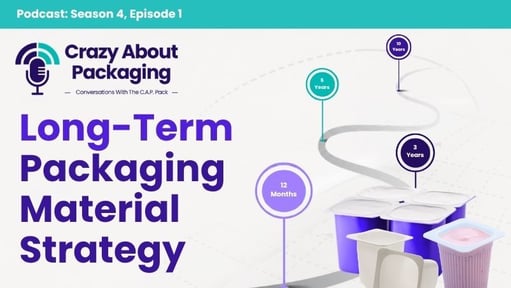
"I think it requires a layered approach. I think you should have a 12 month plan, overlapped by a 3 year plan, overlapped by a 5 year and a 10 year," he said. "If you're not looking further out to 10 years from now, you're going to leave a lot of money on the table. You're also going to paint yourself into that corner. You've got to do it all."
It cuts both ways, and we said so. Plan only for next year and you can make decisions that don't line up with where you'll need to be in 2038. Plan only for 2038 and the market can shift underneath you. The layers are what keep you honest.
Start With Supply, Then Stack the Rest on Top
We covered a lot of factors: sustainability, industry guidelines, the regulatory landscape, supply chain and material availability, recycling infrastructure, recycled content availability and market direction. So we asked the unfair question. If you had to pick one that matters most, what is it?
Natalie went with supply chain and material availability, because everything else branches off of it. If a material is readily available and more supply is coming, there's going to be more access to PCR. Regulations are more likely to favor it. Capacity keeps building. Recycling infrastructure follows. Industry guidelines converge around it.
The investment data points the same way.
"If you look at investment both from a recycling standpoint and from a virgin resin production standpoint, both of those two commodity materials, polypropylene and PET, are expanding," Mike said. "They're expanding in both forms, and I think that should be a real signal that companies should be investing resources, time and platforms that incorporate those materials into packaging."
Then he put it in food terms, which is how most of our analogies end up.
 "Material supply and market dynamics are the cake, and everything else is just the frosting on the cake," he said. "My point, though, is turn the oven on. Start the process. If you don't turn the oven on, all the rest of it is just wishful mixing."
Jonathan's addition was that getting through qualification earns you options.
"Look for the opportunity. See the opportunity," he said. "Can I get a material reduction? Can I expand my product portfolio with a new material? What are those cost implications? Can I increase my market share? There are so many other considerations from an opportunistic perspective."
For food companies already working with tight margins, any opportunity to widen them is worth the look.
It's Complicated, and That's Sort of the Point
Every one of these conversations seems to end in the same place, and this one was no different. These aren't simple decisions, and that's exactly why they take so long.
From the outside it can look like foot dragging. Why can't you just make it sustainable already? But there's a lot going on beneath the surface that doesn't show up to the untrained eye. Qualification requirements, food safety, line performance, regulations, end markets. All of it has to line up.
The next decade is going to bring more change than the last one, and it's going to arrive faster. Starting those conversations early, with partners who can see both the small picture and the big one, is what separates the companies that plan from the companies that panic.
None of which means it can't be done. As Mike put it: "Everything we're talking about, while extremely complicated, complex, it's achievable. How do you eat the elephant? One bite at a time."
Thanks for getting a little crazy about packaging with us! Catch the full episode on Spotify, Apple Podcasts, or on our website, and be sure to subscribe so you don't miss the rest of Season 4.
Working Through Your Packaging Material Strategy?
Material decisions have implications across performance, supply, cost, sustainability and production. If you're evaluating your current packaging materials or considering alternatives, talk with the ICPG team about what you're trying to solve and where your packaging needs to go next.
Frequently Asked Questions About Long-Term Packaging Material Strategy
What is a packaging material strategy?
A packaging material strategy is an approach to selecting and planning packaging materials based on performance, cost, supply availability, sustainability, regulations, recycling infrastructure and market direction.
Why is packaging material selection a long-term strategic decision?
Material decisions used to be evaluated on performance, availability and cost. Today they also carry regulatory exposure, recycling infrastructure dependencies, supply availability risk and capital implications. A material that's convenient today can become expensive or hard to source within the life of the equipment running it, so the decision has to be evaluated over years rather than quarters.
How far ahead should packaging teams plan their material strategy?
A layered approach works better than a single horizon: a 12 month plan overlapped by a 3 year plan, a 5 year plan and a 10 year plan. Short-range plans keep operations running, and the longer horizons keep near-term decisions from conflicting with where regulations, supply and infrastructure are heading.
What signals indicate that a packaging material has long-term viability?
Look at where investment is going. Expanding virgin production capacity and expanding recycling infrastructure both suggest a material is growing rather than contracting. Other useful signals include recycled content availability, whether industry guidelines and regulations are converging around the material and whether producers are adding or closing capacity.
Why are companies moving away from polystyrene?
Polystyrene faces recyclability, regulatory and sustainability challenges, while plant closures are adding concerns around supply availability and pricing.
How long does it take to qualify a new packaging material?
Qualification timelines vary by application, but they're typically measured in months to years rather than weeks. Testing, trials, food safety requirements, line optimization and internal approvals all take time, which is why starting the conversation well before a deadline matters more than moving quickly once one arrives.