


 The global demand for plastic waste reduction and more sustainable packaging solutions has resulted in widespread initiatives to redesign food packaging solutions through various methods including down-gauging, light-weighting, material structure redesign & polymer replacement.
With many brand owners stepping up and making commitments to transition to more sustainable packaging and reduce the amount of material consumption across their portfolio by 2025, the race is on to develop alternative material structures that result in a more sustainable solution, without sacrificing performance, barrier protection, or mechanical properties.
Oh, and let's not forget - without adding cost or requiring significant capital expenditures to replace existing systems and processes. No problem, right?
But what if we told you that you could fulfill all of these requirements - sustainability, performance, compatibility — and reduce overall packaging material cost?
Sound too good to be true? Continue reading to learn about several characteristics of XPP that will help you put more money back to your bottom line.
How Density, Weight, and Yield Reduce Packaging Material Cost
XPP offers enhancements to key properties in the form of a mono-material polypropylene-based barrier packaging solution – without the use of specialty materials, or mineral fillers. This means that XPP maintains the same density and weight as traditional polypropylene.
What does this mean for packaging material cost? Polypropylene has the lowest density & weight of all the polymers with approximately 30% decrease in density compared to PET and a ~13% density reduction compared to HIPS.
This lower density directly correlates to an increase in linear feet of the rollstock material for the same weight. Simply put, you get more parts from the same amount of material — which lowers packaging material cost per unit.
By switching from polymers such as PET or HIPS to XPP, you can see a potential increase in part yield of 13% versus HIPS and 30% versus PET — directly improving packaging material cost efficiency.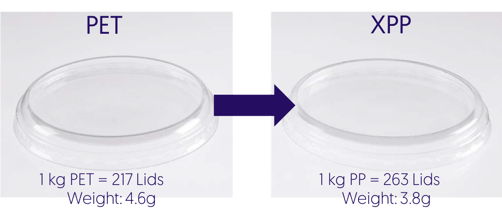
Further savings can be seen downstream as a result of light-weighting including reduced fuel consumption and other transportation efficiencies.
Process Compatibility Reduces Packaging Material Cost and Capital Expenditure
Compatibility with existing systems & processes is possibly one of the most daunting challenges converters and brand owners face when evaluating material replacement whether to achieve sustainability goals or address Proposition 65 concerns.
A solution may check every performance box but become a non-starter if it requires a complete overhaul or replacement of existing systems and processes.
XPP offers enhancements to key properties including improved stiffness and controlled shrinkage to maintain that "snap" characteristic of certain FFS applications, and allow for replacement of PS and traditional PP in thermoforming & FFS processes.
Minimal switching costs and reduced capital expenditure mean savings tied to packaging material cost improvements go directly to your bottom line.

Precision Gauge Control Minimizes Packaging Material Cost
XPP is produced on precision extrusion equipment that offers real-time gauge control and quality monitoring for mono-layer and multi-layer extruded sheet.
The overall gauge, or thickness, of the rollstock structure expressed in mils (thousandth of an inch) has the ability to drastically impact packaging material cost. Rollstock gauge can directly affect part yield in thermoforming and FFS. If the gauge isn’t carefully controlled during extrusion, this can affect overall spend. While it may seem hard to believe that just one thousandth-of-an-inch has the ability to affect overall cost in such a significant way, it’s a hard truth:
| Example: .040 Mil Structure |
|
| +1 Mil | -1 Mil |
| 10,000,000 * 2.5% Overage = +250,000 lbs |
10,000,000 * 2.5% = -250,000 lbs |
| 250,000 * $1.50/lb = $375,000 Added Cost |
250,000 * $1.50/lb = ($375,000) Cost Savings |
Now, multiply that ten-fold, and it becomes clear that down-gauging initiatives and precision gauge control alone have significant influence over packaging material cost.
In addition to ICPG’s precision gauge-control capabilities, XPP also offers enhanced stiffness attributes, which present the opportunity to down-gauge existing structures without sacrificing processing characteristics or barrier performance.
Eliminating Over-Engineering Reduces Packaging Material Cost
While XPP offers enhanced barrier protection in a mono-material format, high-barrier applications requiring EVOH benefit from ICPG’s visionX system, which ensures precision control of individual layers within multi-layer structures.
This eliminates unnecessary over-engineering and prevents adding more EVOH than required to meet barrier specifications.
When controlling packaging material cost, this means using only the exact amount of expensive barrier materials necessary. These precision capabilities also create opportunities to optimize existing high-barrier multi-layer structures and reduce expensive EVOH usage — directly improving packaging material cost efficiency.
Optimize Packaging Material Cost Without Sacrificing Performance
Want to see how these strategies apply to your packaging structure?
Download the Achieving Economic & Environmental Cost Savings with XPP Case Study to review real-world results — or contact our team to evaluate your current application and identify practical cost-reduction opportunities.